


This article was originally posted as a 4-part LinkedIn series, and is recreated here as a single blog.
Your ammo outperforms premium brands, but your packaging looks like a gas station souvenir.
That was the problem I had to solve inside Australian Munitions. Their Australian Outback brand was choking their export growth. They had world-class ammunition wrapped in cartoon packaging. Premium performance at premium prices, but nobody believed it because the brand looked gimmicky.
Flatlined export sales. A UK distributor who refused to touch the product. Reviews praising the ammunition’s accuracy while mocking the kangaroo-and-windmill packaging. The disconnect was killing them.
Why Premium Products Get Stuck Behind Budget Brands
Australian Munitions had launched “Australian Outback” ammunition based on distributor advice that missed the mark completely. Their US partner at the time suggested leaning into outback stereotypes – kangaroos, windmills, and Crocodile Dundee imagery that felt silly to serious shooters.
Manufacturing ammunition in Australia costs more than most markets due to higher labour, materials, and compliance requirements. Australian Munitions competed on performance, with their powder and unprimed cases already carrying global respect under the “ADI World Class” brand. The ammunition performed just as well, but the wrapper told a different story.
People bought Australian Outback as a novelty, then discovered it outperformed premium brands they’d used for years. The performance surprised them because the packaging had set budget expectations. When the packaging tells a joke, the product has to work twice as hard to be taken seriously.
When you make a premium product in a high-cost country, you can’t afford a brand that apologizes for the price. The branding has to carry its weight; otherwise, you’re giving away margin before the box is even opened.
I could see that brand fragmentation was creating market confusion. ADI World Class powders and cases carried serious credibility while Australian Outback ammunition looked like a different company made it. Distributors struggled with positioning, and customers couldn’t connect the quality story across product lines.
The Real Cost of Misaligned Positioning
Bad branding destroys leverage faster than weak sales. Australian Munitions had spent decades building ADI’s reputation for precision and consistency, but none of that equity transferred to the ammunition because it lived under a separate, weaker brand.
Their UK distributor refused to stock the Australian Outback entirely, based solely on brand perception, despite having no performance or pricing concerns. They wouldn’t risk their cash flow on a product whose packaging looked like a gas station novelty.
Private label partners like OSA’s Buffalo River in Australia were producing ammunition that competed directly with Australian Outback, using the same manufacturing lines, processes and components but different branding. The product was cannibalizing itself through brand confusion while export sales stayed flatlined.
Building the Business Case
I built the investment case that made the change inevitable. Flatlined export sales despite growing market demand, zero UK penetration due to brand resistance, and internal inefficiencies from managing multiple brand identities. The current approach was capping growth while confusing customers and distributors.
Getting stakeholder buy-in meant transparency across departments. I worked with production planning on lead times for new packaging, coordinated supplier transitions with purchasing, and provided finance with budget allocation and timing forecasts. Everyone understood the strategic logic once they saw the complete operational picture I’d mapped out.
Rebuilding the Brand Architecture – Without Blowing It Up
The solution required alignment, not reinvention. Australian Munitions already owned a trusted brand in ADI World Class, so I consolidated everything under the established master brand instead of building a new subbrand from scratch.
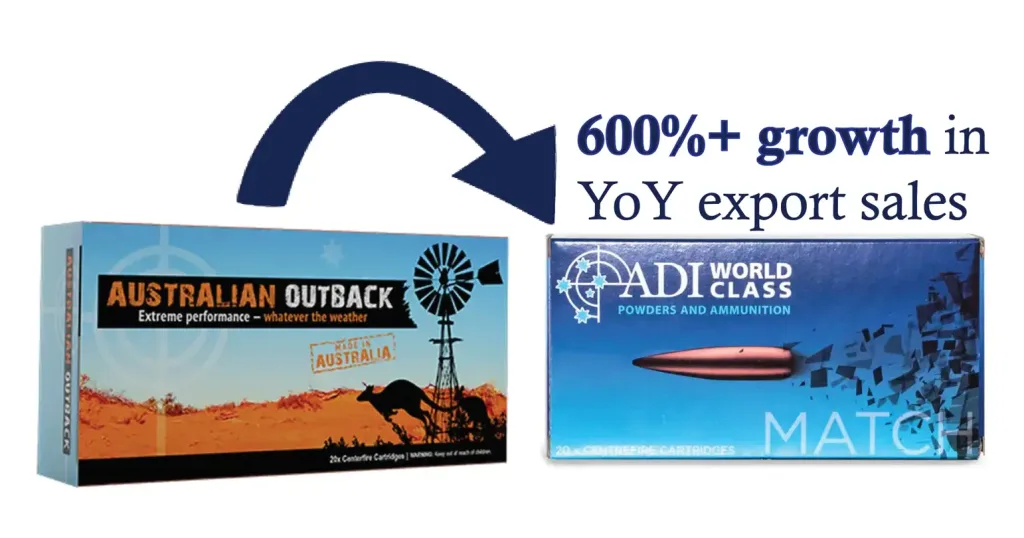
We redesigned the packaging and realigned the story, so it finally matched the product and the price.
No one needed to be convinced it shot well. They needed to believe it belonged on the same shelf as the brands it outperformed.
The packaging change required me to coordinate across purchasing, production planning, legal and compliance, global distribution, and more. Manufacturing 12-24 months in advance means timing is crucial, so I phased out existing inventory without waste while introducing new packaging at optimal production moments.
Results That Speak Louder Than Strategy
Sales jumped over 600% almost immediately after the rebrand without changing the product, pricing, or core distribution strategy. The UK market opened for the first time when the same distributor who refused Australian Outback began stocking ADI World Class ammunition.
Customer reviews shifted focus from packaging novelty to product performance. Serious shooters started comparing ADI ammunition to other premium brands instead of treating it as a curiosity purchase, and pricing pressure disappeared when customers expected premium performance based on the premium branding.
The brand credibility I built removed barriers that had blocked market entry entirely. The ammunition finally carried the same reputation for precision and consistency that ADI’s components had earned over decades.
What This Means for Your Business
Brand confusion creates revenue ceilings that product improvements can’t fix. When packaging doesn’t match performance or pricing, customers make assumptions that work against you regardless of quality.
Australian Munitions already owned a respected brand in ADI World Class – my fix required consolidation and alignment rather than creation and education. Look at your own brand architecture and ask whether you’re fragmenting customer trust across multiple identities when one strong brand could carry everything.
Premium products need premium presentation because misaligned branding makes performance harder to sell. Visual assets should support your price point rather than undermine it, and packaging should help distributors position your product instead of forcing them to explain disconnects.
Market positioning is most effective when it aligns with existing customer expectations. Australian Munitions had the product and the performance; they just needed someone to make their brand match their bullets.
If you’re a product-driven business that knows your offering works but suspects your positioning doesn’t, I can help.
I align what you do with how the market sees you, so your reputation finally supports your revenue.
If the brand doesn’t match the bullet, you’re fighting uphill.
Our Marketing Health Check shows exactly where your messaging helps and where it holds you back—clear visibility on what’s working, what’s missing, and what to fix first.
Author Note: This case study reflects work completed by Ewan Williams in his prior role as Global Sales Manager at Australian Munitions (Thales Australia). Refracted Aspect was not involved in the delivery of this work, but the lessons learned continue to inform our consulting approach today.


